

Fall is a very special time for astrophotography. When during Summer and Winter months we shoot mostly nebulae, and during Spring - mostly small-appearing galaxies, then at Autumn we can choose from a variety of available astrophotography targets - star clusters, galaxies - both huge and tiny, and nebulae - bright and colorful. The Fall night sky is so diverse! Also, when Autumn starts, nights are getting colder, which is good for non-cooled DSLR and mirrorless shooters - camera sensors don't burn as quickly as in the Summer. Also, in Fall, nights finally start sooner during the day, which means more time under the night sky available during one single night. The combination of those few factors makes Autumn a fantastic time to enjoy astrophotography and stargazing! Put on your jacket, set up your astrophotography imaging rig, and check out the 7 best Fall astrophotography targets to shoot in the upcoming Autumn astrophotography season!
Jump to:
1. Andromeda Galaxy (M31)
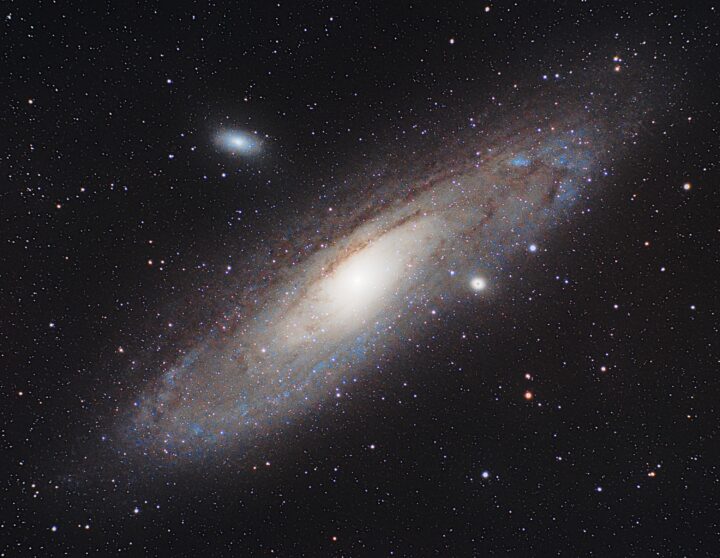
The king of the Fall astrophotography may be the only one - and it's the famous Andromeda Galaxy, our close neighbor. It's a spiral galaxy located in the constellation Andromeda. The galaxy is big, bright, and it's THE first deep-sky astrophotography target every beginner should start with.
| Object | Andromeda galaxy |
| Object type | Barred spiral galaxy |
| Other names | M31, Messier 31, NGC 224 |
| Constellation | Andromeda |
| RA (right ascension) | 00h 42m 44.3s |
| DEC (declination) | +41° 16′ 9″ |
| Apparent magnitude | 3.44 |
| Angular size | 178 × 63 arcmin |
| Age | 10 billion years |
The Andromeda Galaxy, together with the Orion Nebula and the Pleiades Star Cluster (both being Winter targets), are the top 3 beginner astrophotography targets overall every beginner astrophotographer in the Northern Hemisphere starts with. What makes them so special are three factors:
- Brightness. They are so bright, that they can be seen by the naked eye under a moderately light-polluted sky.
- Apparent size. They are just HUGE - actually, the Andromeda Galaxy appears around 6 times bigger than the Moon on the night sky, which means they can be beautifully revealed even with a short telephoto lens such as the Rokinon 135mm f/2.0.
- Pure gorgeousness. They are just beautiful.
2. North America Nebula (NGC 7000/Caldwell 20)
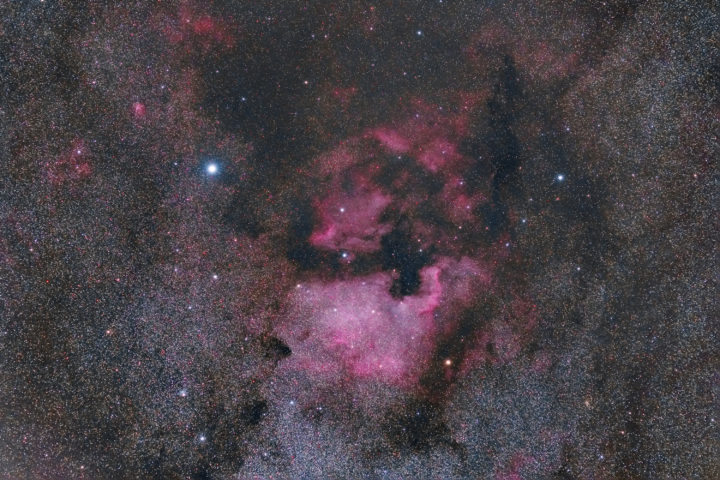
The North America Nebula is an emission nebula in the constellation Cygnus, that is best photographed with a telephoto lens from around 100mm (widefield capture with a lot of neighboring stars) to around 400mm (only the nebula itself).
It's super-bright - you can actually observe the North America Nebula live through a good pair of astronomy binoculars.
Also, it's high in the night sky, which means if you live in a highly light-polluted area, it won't be so much problem - just use a light pollution filter, and you should be able to cut the unwanted artificial light in post-processing (for example by using Dynamic Background Extraction in PixInsight).
| Object | North America Nebula |
| Object type | Emission nebula |
| Other names | NGC 7000, Caldwell 20 |
| Constellation | Cygnus |
| Right ascension | 20h 59m 17.1s |
| Declination | +44° 31′ 44″ |
| Apparent magnitude | 4.0 |
| Apparent dimensions (size) | 120 × 100 arcmin |
Also, remember that the North America Nebula is an emission nebula, so to reveal even more faint details of this target, you can - and almost should! - use an H-alpha narrowband filter!
3. Veil Nebula (Cygnus Loop)
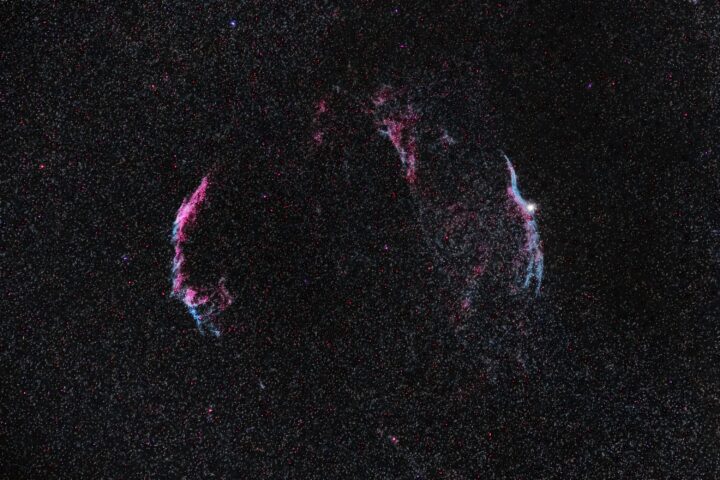
The Veil Nebula, a huge (over 3 degrees!) and very interesting astro-imaging area on the night sky, is one of my favorite targets to focus on during Autumn. What's the best in photographing this complex is the number of ways you can do it.
The main image you see above is the overall, widefield picture of the Veil supernova remnant. I captured it with my telephoto lens (Rokinon 135mm f/2.0) and my APS-C mirrorless camera (Fuji X-T20).
BUT - using a telescope, you can more tightly frame some more interesting parts of this nebula, like The Witch's Broom (The Western Veil/NGC 6960/Caldwell 34), The Eastern Veil (Caldwell 33/NGC 6992/NGC 6995), or The Pickering's Triangle (Pickering's Triangular Wisp). Don't limit yourself to widefield on this fantastic Fall astrophotography target!
| Object | Veil Nebula |
| Object type | Supernova remnant (SNR) |
| Other names | Cirrus Nebula, Filamentary Nebula |
| Constellation | Cygnus |
| Right ascension | 20h 45m 38s |
| Declination | +30° 42′ 30″ |
| Apparent magnitude | 7.0 |
| Angular size | 3 degrees |
4. Pelican Nebula (IC 5070 & IC 5067)
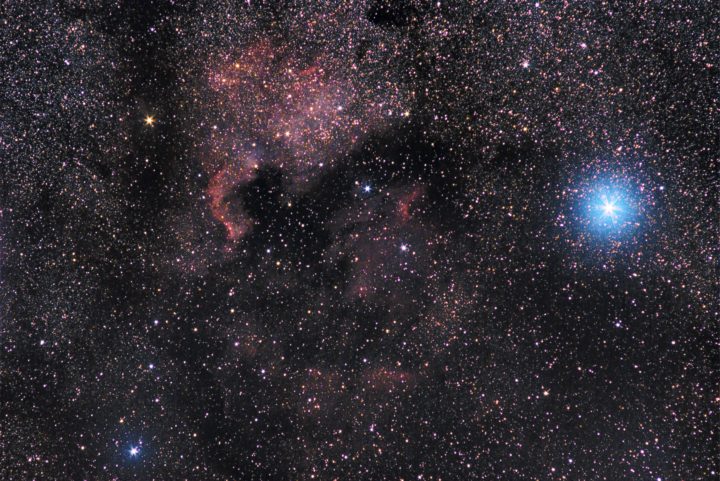
The Pelican Nebula is a close neighbor of the mentioned in point number two the North America Nebula.
Astrophotographers often photograph them together, because they perfectly fit into the telephoto-lenses focal lengths (135mm - 200mm).
If you want to frame them separately, use a telescope with some longer focal length (like 400mm - 500mm).
| Object | Pelican Nebula |
| Object type | Emission nebula (H II region) |
| Other names | IC 5070 & IC 5067 |
| Constellation | Cygnus |
| Right ascension | 20h 50m 48s |
| Declination | +44° 20′ 60″ |
| Apparent magnitude | 8.0 |
| Apparent dimensions (size) | 80 × 60 arcmin |
As with the North America Nebula - to further reveal more details from the Pelican Nebula, use a narrowband H-alpha filter (even on a DSLR camera).
5. Triangulum Galaxy (M33)
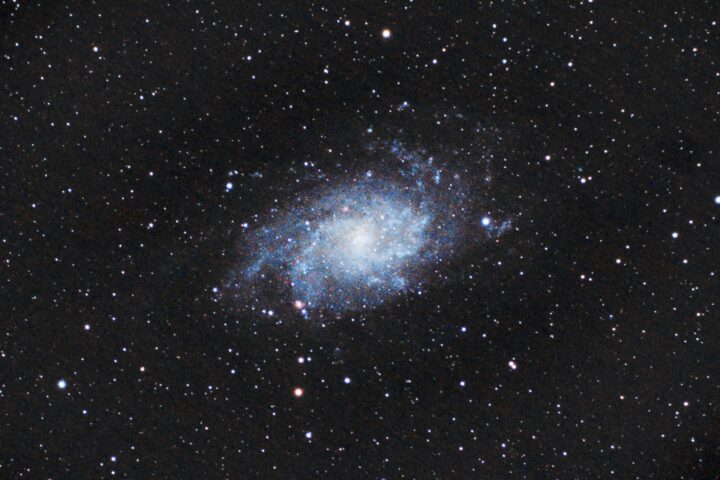
Triangulum Galaxy, the smaller companion of the Andromeda Galaxy, and the third-largest galaxy in the Local Group (first being the Andromeda Galaxy, and second our own Milky Way). Not as bright and not as big on the night sky as the M31, but still a relatively easy beginner astrophotography target.
Maybe it's not huge enough for a telephoto lens (yet you can still reveal some details using a Rokinon 135mm or SMC Takumar 200mm), but a small APO telescope (like the Sky-Watcher Evostar 72ED) is all you need to successfully capture incoming photons from this galaxy!
| Object | Triangulum Galaxy |
| Object type | Spiral galaxy |
| Other names | M33, Messier 33, NGC 598 |
| Constellation | Triangulum |
| Right ascension | 01h 33m 50s |
| Declination | +30° 39′ 37″ |
| Apparent magnitude | 5.7 |
| Apparent dimensions (size) | 62 × 39 arcmin |
6. Crescent Nebula (NGC 6888)
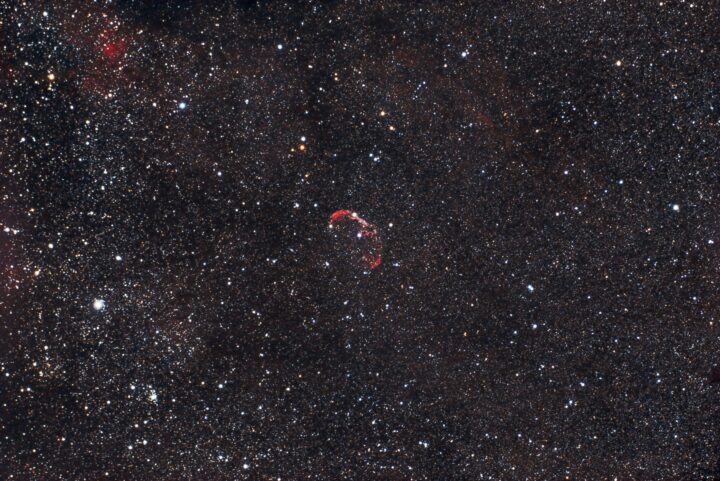
The small (apparently) brain-like nebula - this has to be the Crescent Nebula! Another good Fall astrophotography target for your telescope.
The secret to a good picture of this nebula is to limit the number of stars on the final photo.
You can do this in two ways - by capturing the photons using narrowband filters (not the perfect fit for a DSLR camera, but still doable - especially when using an astro-modified one), and by reducing the stars in post-processing (for example by using a star mask and morphological transformation process in PixInsight).
| Object | Crescent Nebula |
| Object type | Emission nebula |
| Other names | NGC 6888, Caldwell 27, Sharpless 105 |
| Constellation | Cygnus |
| Right ascension | 20h 12m 07s |
| Declination | +38° 21′ 00″ |
| Apparent magnitude | 7.4 |
| Apparent dimensions (size) | 20 × 10 arcmin |
7. Dumbbell Nebula (M27)
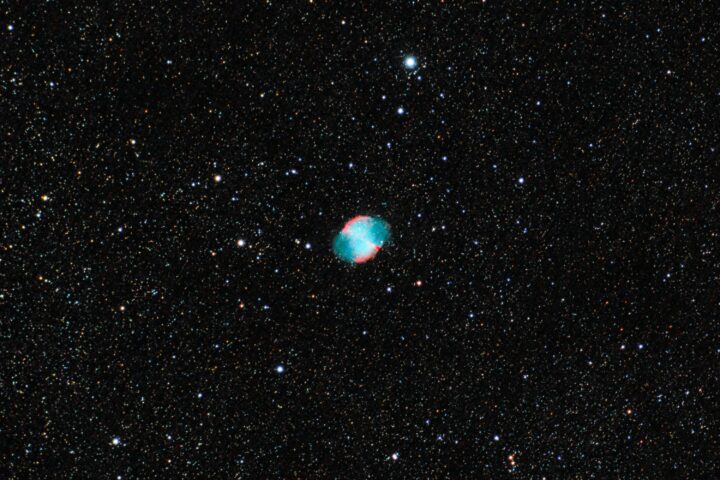
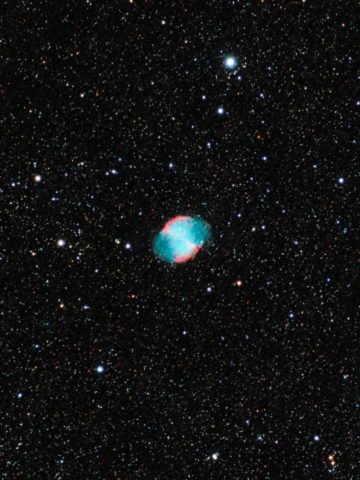
A small (apparently) and hidden from the naked eye planetary nebula located in the constellation Vulpecula - it's nothing else but the Dumbbell Nebula!
Again, a good target for a telescope, not so for a telephoto lens. Be sure to polar align your equatorial mount as accurately as you can - you want to reveal as much detail from this little beauty as you can, and a proper alignment is fundamental!
| Object | Dumbbell Nebula |
| Object type | Planetary nebula |
| Other names | M27, Messier 27, NGC 6853, Apple Core Nebula |
| Constellation | Vulpecula |
| RA (right ascension) | 19h 59m 36s |
| DEC (declination) | +22° 43′ 16″ |
| Apparent magnitude | 7.3 |
| Apparent dimensions (size) | 8 × 7 arcmin |
Is Fall already gone? You are photographing late in the night (almost in the morning)? Those Winter targets are your next to work on!
Comments
No Comments